1 May 2026
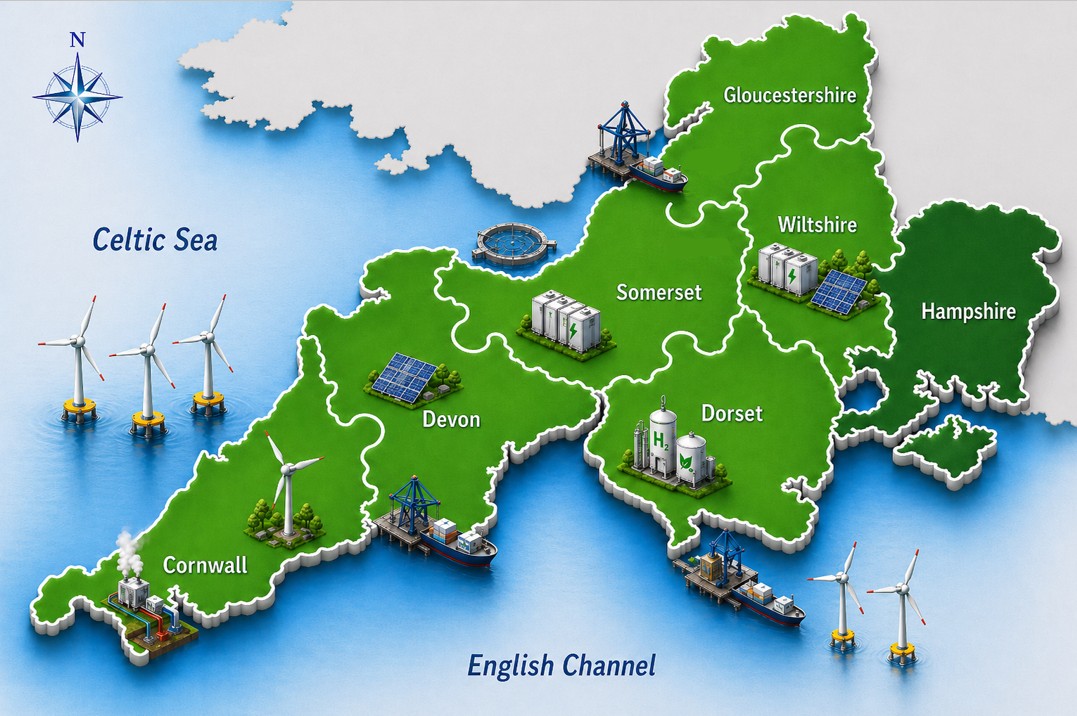
Throughout the last century, energy policy has reflected the principle Winston Churchill set out to Parliament in 1913 “Safety and certainty in oil lie in variety and variety alone.” It’s a principle that keeps being tested as ongoing geopolitical tensions and instability continue to expose the UK to volatile global energy prices. As a result, the case for diversifying domestic clean power generation across multiple regions has never been stronger.
Indeed, nowhere is that case more visible than in the South West. This was the backdrop to a roundtable Dr Steve Freeman attended. It was hosted by South West Business Insider and law firm Birketts, who brought together developers, community energy leaders, industrial cluster leads, The Crown Estate, legal specialists and trade associations to examine the future of clean energy in the South West.
The region hosts a range of clean energy and innovation capabilities unmatched anywhere in the UK[1]. Specifically, its portfolio spans floating offshore wind, nuclear, geothermal, hydrogen, wave, tidal, onshore wind, solar, battery manufacturing and critical minerals. Notably, all of this sits within reach of major South West ports serving Atlantic, Celtic Sea, Channel and Irish trade routes[2]. That combination is putting the region at the centre of the national conversation.
The South West is no longer a peripheral player in the UK energy transition. For example, floating offshore wind in the Celtic Sea has moved decisively from ambition to delivery, with 4.5 GW now under lease [3]. Somerset is home to Hinkley Point C, one of Europe’s largest energy projects [4]. Once operational, it will provide 3.2 GW of low-carbon electricity, equivalent to around 10% of the UK’s current electricity demand [5]. Agratas is also constructing a 40 GWh battery-cell manufacturing facility near Bridgwater, which will be one of the largest in Europe [6, 7].
However, regional delivery is not limited to nationally significant projects as community-led generation is also gaining traction. Bristol’s Lawrence Weston turbine, for instance, is England’s largest fully community-owned onshore wind project and has been operational since 2023 [8]. In Cornwall, the Imerys Wind Farm near St Austell recently secured the largest English onshore wind CfD contract in a decade [9]. Meanwhile, the Bristol City Leap partnership between Bristol City Council, Vattenfall and Ameresco is delivering one of the UK’s most advanced city-scale heat networks by drawing heat from a combination of low-carbon sources [10].
Taken together, these are not isolated projects. They are the foundations of an integrated regional energy ecosystem capable of supporting domestic power security, supply-chain growth and industrial decarbonisation. Diversifying generation across geographies and technologies is one of the most effective tools the UK has to strengthen energy resilience and attract inward investment for long-term industrial growth.
Grid access and power supply dominated the discussion. The National Energy System Operator (NESO) has launched its Connections Reform, moving the system from “first come, first served” to “first ready, first connected” [11]. However, the reforms are intended to unlock investment at scale, but network capacity on the ground remains insufficient to support the businesses, projects and infrastructure ready to deliver clean power and economic growth.
For instance, this constraint is becoming particularly visible as new hyperscale data centres seek to locate in the region. These electricity-intensive industries typically require over 100 MW each [12] with the largest AI-driven proposals in the UK approaching 1 GW.
The South West is now hosting a substantial data centre pipeline. In Somerset, a 500 MW hyperscale facility is proposed at Bridgwater [13]. Ark Data Centres’ long-established Spring Park campus in Wiltshire operates five data centres serving UK Government departments [11]. And Bristol hosts Isambard-AI, the UK’s most powerful supercomputer, with a National AI Data Facility planned alongside it [14].
However, demand-side grid connection requests have already jumped from 41 GW to 125 GW in nine months [11], placing data centres, clean generation and advanced manufacturing in direct competition for access to power. Nevertheless, the shift toward a more strategic, system-led approach to network planning is welcome, but until it translates into deliverable infrastructure locally, it remains a brake on growth rather than an accelerator.
While policy uncertainty has long been a risk factor in investment decisions, concerns about the long-term durability of the UK’s renewable energy policy are now intensifying. They are casting doubt on the investment commitments needed to deliver projects across electoral cycles.
By contrast, The Crown Estate’s Marine Delivery Routemap and its £50 million Supply Chain Accelerator are giving developers and investors clearer visibility of future opportunities. In December 2025, the Accelerator backed Morwind’s feasibility work for Channel Gateway at Portland Port, a proposed deep-water offshore wind port positioned to support Celtic Sea floating wind and future English Channel offshore wind deployment.
Strategic clarity, sustained over time, provides the long-horizon signal that attracts international capital.
Clean energy clusters are already taking shape across the South West, some led by place-based public-private partnerships, others convened through national policy frameworks.
A place-based example is the Dorset Clean Energy Super Cluster, which is bringing together offshore wind, green hydrogen, carbon storage, nuclear, port infrastructure, defence-sector capability, and supply-chain development into a coordinated platform for growth. With around £28 billion in inward investment poised to regenerate coastal communities across South Dorset and the wider region, it demonstrates how regional assets, aligned around a shared industrial proposition, can deliver against the UK’s clean power and growth missions [15].
The West of England Industrial Cluster, established in 2023 through the Local Industrial Decarbonisation Plans (LIDP) competition, is connecting industrial decarbonisation, hydrogen, carbon capture and energy-intensive manufacturing across the Portbury, Avonmouth and Severnside industrial corridor [16].
These clusters demonstrate the value of coordination, but sustaining it over the longer term will also depend on closer alignment with regional planning. Spatial Development Strategies (SDSs) offer a new statutory route to embed this coordination across local authority boundaries. Prepared by strategic planning authorities, they establish a high-level framework for growth, land use and strategic infrastructure over at least 25 years. Although they cannot allocate individual sites, they can identify broad locations for development and infrastructure. Once adopted, they form part of the development plan, and statutory local plans must be in general conformity with them [17,18].
Alongside this, Local Area Energy Plans (LAEPs) identify the changes and infrastructure needed to decarbonise local energy systems [19]. For clean energy clusters, this creates the potential for a two-way relationship. LAEPs and cluster investment pipelines could inform SDS preparation by identifying future grid, port, industrial and generation needs. In turn, SDSs could reflect these needs within wider land-use and growth priorities. Used effectively, this feedback loop could help bridge policy silos, strengthen public-private coordination and give SMEs earlier visibility of regional opportunities.
Together, energy clusters, SDSs and LAEPs could provide the cross-sector coordination needed to connect regional project pipelines with national policy, infrastructure and investment priorities.
The takeaway from the discussion was that the South West has built a deep, diverse and demonstrable clean energy proposition, but national ambition must now catch up and align with regional delivery. What has emerged is not a collection of projects and initiatives, but an integrated regional energy ecosystem capable of supporting decarbonisation, the economic renewal of coastal communities, and national resilience.
Sustaining this momentum will depend on three conditions:
Ultimately, meeting these conditions makes the South West not just a contributor to the UK’s clean energy transition but a cornerstone of its long-term energy security and industrial growth.
[1] Great South West (2023). Clean Energy Powerhouse Prospectus. Developed by Regen. Available at: https://greatsouthwest.co.uk/wp-content/uploads/2023/08/Great-South-West-Energy-Prospectus-online.pdf (Accessed: 30 April 2026).
[2] Maritime UK South West (2024). Maritime Investment Sites: South West UK. Available at: https://maritimeuksw.org/maritime-investment-sites-south-west-uk/ (Accessed: 30 April 2026).
[3] The Crown Estate (2025) Offshore Wind Leasing Round 5. Available at: https://www.thecrownestate.co.uk/our-business/marine/round-5 (Accessed: 30 April 2026).
[4] Office for Nuclear Regulation (2022). Hinkley Point C presents unique opportunity to set standard for construction safety. Published 24 March 2022. Available at: https://www.onr.org.uk/news/all-news/2022/03/hinkley-point-c-presents-unique-opportunity-to-set-standard-for-construction-safety (Accessed: 1 September 2026).
[5] EDF Energy (2026). Hinkley Point C Socio-economic and Environmental Impact Report 2026. pp. 58–59. Available at: https://www.edfenergy.com/sites/default/files/2026-05/Hinkley%20Point%20C%20Socio-economic%20and%20Environmental%20Impact%20Report%202026.pdf (Accessed: 1 September 2026).
[6] Department for Business and Trade (2026). Business Secretary champions flagship investment in UK’s largest gigafactory. Published 9 April 2026. Available at: https://www.gov.uk/government/news/business-secretary-champions-flagship-investment-in-uks-largest-gigafactory (Accessed: 1 September 2026).
[7] Somerset Council (2024) Momentous day for Somerset as gigafactory plans move forward. Available at: https://www.somerset.gov.uk/news/momentous-day-for-somerset-as-gigafactory-plans-move-forward/ (Accessed: 30 April 2026).
[8] Ambition Community Energy (n.d.). Powering progress in Lawrence Weston with community energy. Available at: https://ambitioncommunityenergy.org/ (Accessed: 1 September 2026).
[9] Imerys Wind Farm: Department for Energy Security and Net Zero (2026) New auction delivers unprecedented clean, homegrown power. Available at: https://www.gov.uk/government/news/new-auction-delivers-unprecedented-clean-homegrown-power (Accessed: 30 April 2026).
[10] Vattenfall Heat UK (2025) Bristol Heat Network. Available at: https://heat.vattenfall.co.uk/where-we-are/bristol/bristol-heat-network/ (Accessed: 30 April 2026).
[11] National Energy System Operator (2025) NESO implements electricity grid connection reforms to unlock investment in Great Britain, 8 December 2025. Available at: https://www.neso.energy/neso-implements-electricity-grid-connection-reforms-unlock-investment-great-britain (Accessed: 30 April 2026).
[12] Oxford Economics (2026) The rising challenge of powering data centres. Available at: https://www.oxfordeconomics.com/resource/the-rising-challenge-of-powering-data-centres/ (Accessed: 30 April 2026).
[13] Datacenter Dynamics (2026) 500MW data center campus planned in Somerset, UK, 18 February 2026. Available at: https://www.datacenterdynamics.com/en/news/500mw-data-center-campus-planned-in-somerset-uk/ (Accessed: 30 April 2026).
[14] House of Commons Library (2025) Data centres: research briefing, 3 November 2025. Available at: https://researchbriefings.files.parliament.uk/documents/CBP-10315/CBP-10315.pdf (Accessed: 30 April 2026).
[15] Dorset Council (2025) Crown Estate supports feasibility study for offshore wind port at Portland, December 2025. Available at: https://www.dorsetcouncil.gov.uk/news/crown-estate-supports-feasibility-study-for-offshore-wind-port-at-portland (Accessed: 30 April 2026).
[16] West of England Industrial Cluster (2024) About the WEIC. Available at: https://weic.co.uk/ (Accessed: 30 April 2026).
[17] UK Parliament (2025). Planning and Infrastructure Act 2025, c. 34: Explanatory Notes, Chapter 2—Spatial development strategies. Available at: https://www.legislation.gov.uk/ukpga/2025/34/notes/division/7/index.htm (Accessed: 1 September 2026).
[18] Ministry of Housing, Communities and Local Government (2026). National Planning Policy Framework. Policy PM1: Spatial Development Strategies. Published 17 August 2026. Available at: https://www.gov.uk/guidance/national-planning-policy-framework (Accessed: 1 September 2026).
[19] Energy Systems Catapult (2022). Building a governance framework for coordinated Local Area Energy Planning. Published 4 July 2022. Available at: https://es.catapult.org.uk/report/governance-framework-for-coordinated-local-area-energy-planning/ (Accessed: 1 September 2026).