19 June 2026

I recently spoke at RenewableUK Global Offshore Wind 2026 on the role of regional clean energy clusters in the next phase of offshore wind delivery.
The focus was the Dorset Clean Energy Super Cluster and why it matters for energy security, industrial growth and coastal regeneration [1].
This short article summarises the main points from my presentation [click to download]
For much of the last two decades, the objectives of offshore wind have been to reduce cost, increase deployment and prove it could become a mainstream source of electricity. That case has now been made, and the UK is a leading example, with offshore wind supplying close to a fifth of its electricity [2].
But the context has shifted. Since the gas shock of 2022, energy has moved to the centre of geopolitics, and clean power has become a core issue for national security [3, 4]. Whilst that debate rages, offshore wind has quietly cut UK spending on imported fuel by an estimated £30 billion [5]. However, offshore wind is now being asked to do more than generate clean power. It must also support energy security, industrial growth and regional investment, and that changes the conversation.
The next phase of offshore wind is increasingly about how projects connect into places and regional strategies [6, 7]. Dorset is one such example, where the Dorset Council has taken the lead in convening a clean energy cluster locally rather than waiting for national direction.
Three shifts are reshaping the role of offshore wind in the UK.
Responding to these shifts is the opportunity all clusters offer.
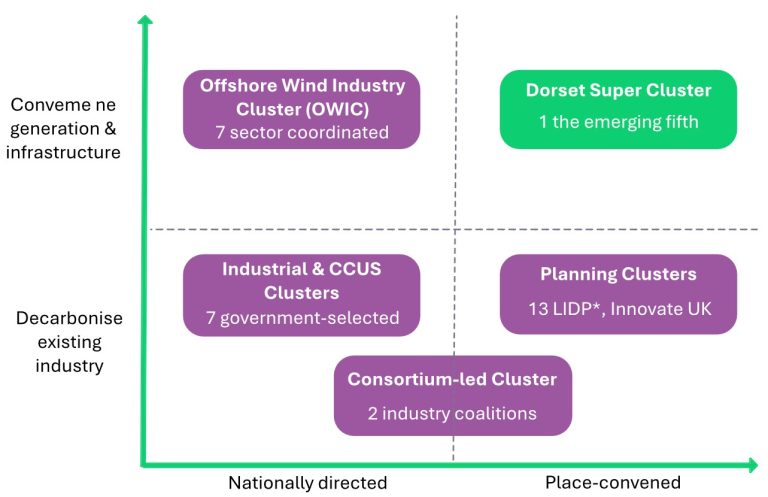
Across the UK, there are broadly four types of energy cluster (Exhibit 1). Some are government-selected industrial decarbonisation clusters. Some are offshore wind clusters coordinated through the sector. Others are consortium-led, or focused on local industrial decarbonisation planning. Each has its value, but the Dorset Cluster offers a slightly different “fifth” type.
Exhibit 1: Four types of UK energy cluster (shaded blue), positioned by how they are convened and what they set out to do, with the Dorset Cluster as an emerging fifth (green shading).
Source: Author’s own analysis, REP Ltd.
The Dorset Cluster did not begin with a government designation or a single formal route to market. It emerged from place, geography and necessity – bringing together developers, investors, local authorities, ports and regional stakeholders before formal market mechanisms are fully in place.
Developers and regional partners are not waiting for perfect conditions before acting. They are working to create the conditions for delivery in advance. That means building alignment, surfacing constraints, coordinating timelines and showing how individual projects can add up to a coherent regional proposition. This pre-market coordination could let Dorset move quickly once a route to market opens.
The Cluster is centred on Portland Port, which brings together a set of assets that are difficult to replicate nationally (Exhibit 2). These include, deep-water access, a naturally sheltered harbour, maritime heritage, defence relevance and proximity to major offshore wind opportunities in the South West and the Celtic Sea. It also sits within a geology that includes salt caverns that are ideally suited to green hydrogen and carbon capture storage [13].
Exhibit 2: The Dorset Clean Energy Super Cluster and its main components, centred on Portland Port.

Source: Dorset Clean Energy Super Cluster
What gives Dorset its strategic relevance is the combination of its assets and its alignment with regional and local needs. The Channel Gateway concept at Portland Port adds to this logic [14]. This proposed £500 million clean energy port has already drawn early backing from The Crown Estate’s (TCE) Supply Chain Accelerator Fund (£750,000) and matched funding from Dorset Council (£375,000) [15]. It is designed to serve both fixed and floating offshore wind, to grow the regional supply chain, and to link the English Channel to the Celtic Sea’s floating wind market [16].
That bridging role matters because the Channel’s fixed-bottom wind can come forward sooner than the Celtic Sea’s floating wind, building the supply chain and port capacity that floating can then draw on. Dorset complements the Celtic Sea, and together they strengthen the wider South West clean energy proposition and its supply chain.
By design, energy policy is top down. National targets are set, the schemes and funding mechanisms follow, and developers and projects are left to deliver against them. But delivery happens in places, where skills, planning authorities, communities, investors and supply chains convene around local infrastructure. Whilst national ambition may be strong, progress often falls behind when coordination between national policy and place is weak.
That gap is now closing, as TCE and the National Energy System Operator (NESO) work to connect national strategy with regional delivery. NESO is doing so through its first Regional Energy Strategic Plans [6], and TCE is aligning its future seabed leasing with them and investing up to £400 million in supply chains and ports across the regions [7]. But these are national instruments reaching down.
Dorset shows what regional delivery looks like when it is built from the place up. And the opportunity is more than clean power. It is inward investment, jobs, skills, supply chain readiness, industrial growth, coastal regeneration and energy security. But those benefits must be earned. They need sequencing and a clear regional proposition, which is what the Dorset Cluster is trying to provide.
The Dorset Cluster emerged from a very practical local concern. There was anxiety that several major infrastructure projects could arrive at once, placing pressure on housing, roads, services, workforce availability and local communities. For a local authority, that concern is understandable as major infrastructure can create pressure if it is poorly sequenced or poorly explained.
The reality, however, was more nuanced. The projects were not all arriving at the same time. They had different development pathways, different timelines and different pre-market hurdles, and were more likely to develop over ten to twenty years than to land as a single short-term shock.
Instead of seeing these projects as a near-term burden, Dorset saw them as part of a long-term regional pathway. That is an important shift, which turns infrastructure pressure into an investment opportunity. It also shows why place-convened clusters matter. They create a space where regional actors can help shape how projects are sequenced before major decisions are locked in.
The Dorset example offers three wider lessons.
That is why Dorset is more than a clean energy location, with the potential to be a delivery partner in the UK’s wider energy security and industrial growth agenda.
The ask is straightforward.
The Dorset Cluster is about more than offshore wind. It is about how a place, rather than a policy, can convene clean energy from the ground up. How offshore wind, ports, hydrogen and supply chains connect into a regional growth story that links national energy security with local jobs and coastal renewal. That is why Dorset matters.
[1]. Invest in Dorset (no date) Dorset Clean Energy Super Cluster. Available: https://www.investindorset.com/dorset-clean-energy-super-cluster (Accessed: 2026,18 June).
[2]. Offshore Wind (2026) Offshore wind supplied nearly one-fifth of UK electricity in 2025. Available: https://www.offshorewind.biz/2026/05/13/offshore-wind-supplied-nearly-one-fifth-of-uk-electricity-in-2025/ (Accessed: 2026, 18 June).
[3]. International Energy Agency (2025) World Energy Outlook 2025. Available: https://www.iea.org/reports/world-energy-outlook-2025 (Accessed: 2026,18 June).
[4] Department for Energy Security and Net Zero (2026) The era of clean energy security [speech]. Available: https://www.gov.uk/government/speeches/the-era-of-clean-energy-security (Accessed: 2026, 18 June).
[5]. Energy and Climate Intelligence Unit (2025) Offshore wind has cut UK’s spending on imported fuels by at least £30bn. Available: https://eciu.net/media/press-releases/2025/offshore-wind-has-cut-uks-spending-on-imported-fuels-by-at-least-30bn (Accessed: 2026, 18 June).
[6]. National Energy System Operator (2025) Regional Energy Strategic Planning (RESP). Available: https://www.neso.energy/what-we-do/strategic-planning/regional-energy-strategic-planning-resp (Accessed: 2026, 18 June).
[7]. The Crown Estate (2026) £15m funding through Supply Chain Accelerator. Available: https://www.thecrownestate.co.uk/news/15m-funding-through-supply-chain-accelerator (Accessed: 2026, 18 June).
[8]. Department for Energy Security and Net Zero (2024) Clean Power 2030 Action Plan: a new era of clean electricity – main report. Available: https://www.gov.uk/government/publications/clean-power-2030-action-plan/clean-power-2030-action-plan-a-new-era-of-clean-electricity-main-report (Accessed: 2026, 18 June).
[9]. International Energy Agency (2022) World Energy Outlook 2022. Available: https://www.iea.org/reports/world-energy-outlook-2022 (Accessed: 2026, 18 June).
[10]. Energy-Storage.news (2026) Another record-breaking year for UK battery storage as 4GWh comes online. Available at: https://www.energy-storage.news/another-record-breaking-year-for-uk-battery-storage-as-4gwh-comes-online/ (Accessed: 18 June 2026).
[11]. Department for Energy Security and Net Zero (2024) Clean Power 2030 Action Plan: a new era of clean electricity – main report. Available: https://www.gov.uk/government/publications/clean-power-2030-action-plan/clean-power-2030-action-plan-a-new-era-of-clean-electricity-main-report (Accessed: 2026, 18 June).
[12]. Energy Institute (2026) Planning consent granted for 4 GW of UK offshore wind. Available: https://knowledge.energyinst.org/new-energy-world/article?id=150316 (Accessed: 2026,18 June).
[13]. UK Energy Storage (2026) UK Energy Storage: the UK’s largest underground salt cavern hydrogen storage project. Available: https://ukenergystorage.co.uk/ (Accessed: 2026, 18 June).
[14]. Channel Gateway (2025) Feasibility study to develop offshore wind port facility at Portland gets go-ahead. Available: https://channelgateway.co.uk/feasibility-study-to-develop-offshore-wind-port-facility-at-portland-gets-go-ahead/ (Accessed: 2026, 18 June).
[15]. Dorset Council (2026) Dorset Council backs Morwind feasibility study to drive growth and power Dorset’s future. Available: https://www.dorsetcouncil.gov.uk/news/dorset-council-backs-morwind-feasibility-study-to-drive-growth-and-power-dorset-s-future-1 (Accessed: 2026, 18 June).
[16]. Offshore Wind (2026) Ocean Winds enters lease agreement with Crown Estate for 1.5 GW Celtic Sea floating wind project. Available: https://www.offshorewind.biz/2026/03/03/ocean-winds-enters-lease-agreement-with-crown-estate-for-1-5-gw-celtic-sea-floating-wind-project/ (Accessed: 2026, 18 June).
[17]. Regen (2025) Go West! An analysis of the energy system benefits and policy implications of a more geographically diverse offshore wind portfolio. Available: https://www.regen.co.uk/insights/go-west (Accessed: 2026,18 June).
[18]. Dorset Council (2025) Deprivation topic data. Available: https://gi.dorsetcouncil.gov.uk/insights/topics/Topic/Deprivation (Accessed: 2026, 18 June).
[19]. Invest in Dorset (n.d.) Dorset Clean Energy Super Cluster. Available: https://www.investindorset.com/dorset-clean-energy-super-cluster (Accessed: 2026, 18 June).
[20]. The Crown Estate (2026) Offshore Wind Leasing Round 6. Available: https://www.thecrownestate.co.uk/our-business/marine/offshore-wind/round-6 (Accessed: 2026, 18 June).